
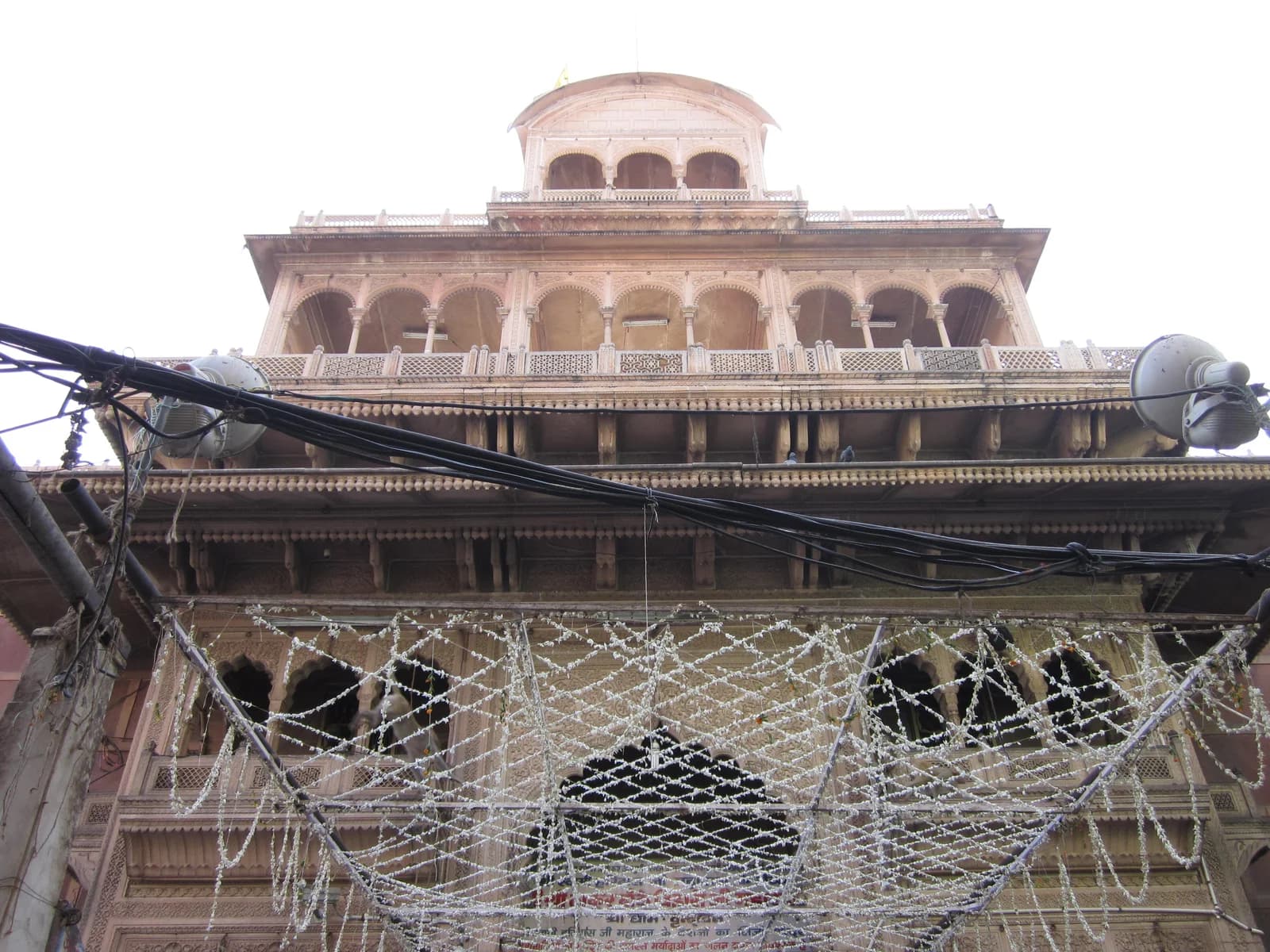
Rangji Mandir Vrindavan timings: The Sri Rangji Temple Trust publishes Mangala Aarti and Vishwaroop Darshan at 5:30 am, a September–March midday darshan closure from 12 noon to 3 pm, evening aarti from 6:00 to 6:30 pm, and final closure at 9:00 pm. These are published worship-schedule entries, not a guarantee of uninterrupted entry. Before travelling, check the official darshan schedule, especially during festivals. Rangji is best combined with nearby Katyayani Devi Temple in Radha Bagh; it can also be paired with Shahji Temple and the Banke Bihari area, although that second leg requires a longer walk through Old Vrindavan or a local ride.
Rangji Mandir opening times and aarti schedule
Sri Rangji Mandir, also known as Sri Ranganathji Temple, has an elaborate daily sequence of sevas. The temple's official pages describe two seasonal schedules: April–August and September–March. For the current November season, the following entries are the most useful to visitors:
Mangala Aarti and Vishwaroop Darshan5:30 amEarly-morning worship, not a promise that every section is openDivya Aradhan6:30–7:30 amMorning ritual periodBhog and prasad distribution8:00–9:00 amService period; darshan may pauseMidday closure12:00–3:00 pmAvoid arriving solely for darshan during this periodEvening aarti6:00–6:30 pmPublished for days without a special processionFinal darshan closure9:00 pmLast published daily closure timeFor April–August, the trust lists a midday closure of 11:00 am–4:00 pm, but one official table also shows an 11:30 am–noon darshan entry, so the exact morning transition needs confirmation. Its two official pages also differ over summer evening aarti: one states 6:00–6:30 pm, another 6:30–7:00 pm. Treat summer aarti timing as unconfirmed until the temple confirms it. The trust notes that special occasions can alter its timetable and that short darshan openings may follow bhog.
For confirmation, the trust lists +91 565 2442787 and +91 8130808180, with calling hours of 6:00 am–noon and 4:00–8:00 pm. Check daily sevas as well as the darshan page. Telephone confirmation of today's arrangements has not been obtained for this guide.
Rangji Mandir history: why a South Indian temple stands in Braj
Rangji Mandir is a meeting of two Vaishnava landscapes: the sacred Krishna geography of Vrindavan and the Sri Vaishnava ritual and architectural traditions of South India. The principal deity is worshipped as Sri Goda-Rangamannar, bringing together Lord Ranganatha and Goda Devi, better known as Andal. Andal's devotional poetry expresses longing for Krishna; the temple's account connects that longing with her desire to be with the Lord in Vrindavan.
According to the temple trust's history, Sri Rangadeshik Swamiji inspired the project, supported by Mathura patrons Seth Radhakrishnaji and Seth Govind Dasji. Craftspeople came from Srirangam, construction began in 1845, and the complex was completed in 1851. The trust describes the design as inspired by Srirangam's Sri Ranganathaswamy Temple but adapted through local workmanship. This explains why Rangji feels quite different from Vrindavan's smaller, lane-side shrines.
Architecture worth noticing inside the complex
The strongest visual contrast is between the layered Dravidian-style gopurams and the carved sandstone gateways associated with northern craftsmanship. The trust describes five concentric rectangular enclosures, a seven-storeyed western gopuram and a five-storeyed eastern one. The eastern gate is identified as the main gate, although the trust says both gates provide access; which is in use for ordinary visitors may vary.
Look for the Pushkarini, the temple water tank; the temple's Andal-associated garden; the various smaller sanctums; and the tall Dhwaja Stambha, often called Sone Ka Khamba. Do not assume every enclosure is open to visitors or that photography is permitted. The trust announced structural work and gold-plating renovation on the Dhwaja Stambha beginning in November 2026, so its appearance and the surrounding access may be affected. Confirm any restrictions locally and respect areas reserved for priests or rituals.
Brahmotsavam and Rangji's Rath ka Mela
Brahmotsavam is the temple's major annual festival, usually associated with the Chaitra period in March or April. Its programme runs across ten days and includes ritual processions on different vahanas, or ceremonial mounts, alongside chanting and music. The large wooden chariot kept by the western side of the complex is especially associated with the festival's Rath ka Mela. The temple trust describes the chariot procession as an annual event, not an everyday attraction.
For quieter architectural viewing, choose a non-festival day. Those who specifically want the procession should expect restricted movement and considerable crowd pressure and should arrange their day around the temple's festival notices. Do not assume a previous year's festival dates or procession route will apply to your visit. Other observances, including Vaikuntha Ekadashi, can also change access and timings.
Combine Rangji Mandir with Katyayani Devi Temple
The most natural pairing is Rangji Mandir and Katyayani Peeth in the Radha Bagh area. Katyayani is a Shakti shrine rather than a Sri Vaishnava temple, so visiting both makes for a distinctive morning: first the South Indian-inspired Rangji complex, then worship of Devi Katyayani. The Katyayani Trust says its present temple was consecrated in 1923 and houses the goddess alongside other principal deities.
The Katyayani Trust publishes a daily 7:00 am opening and a noon closure after aarti, with a brief closure stated between 11:30 am and noon. It also mentions evening worship but does not establish a reliable evening visitor window on the page checked. Therefore, for a two-temple outing, morning is the safer choice. The shrines are in the same broader Rangji–Radha Bagh locality, but a map's short point-to-point distance is not a verified gate-to-gate walking route. Follow the currently accessible street approach and ask locally for the Katyayani Peeth entrance.
Is Rangji near Banke Bihari Temple? Route choices
Rangji belongs to Old Vrindavan, but it is not immediately beside the Banke Bihari temple gate. Local guides put the sites roughly 1–2 km apart depending on measurement and route; the actual walk through lanes can be longer. It is better to think of two connected pockets: Rangji–Katyayani on one side, and the Banke Bihari–Loi Bazaar shrine cluster on the other. Shahji Temple or the Govind Dev area can serve as optional intermediate stops if their opening hours and your energy permit.
Option 1: a focused Rangji and Katyayani morning
Start at Rangji during its published morning darshan window, allow time to appreciate the courtyard and gopuram, then go to Katyayani Peeth before its published noon closure. This avoids making a tight Banke Bihari queue part of the same morning. It is the stronger choice for visitors interested in temple history, architecture, Devi worship or a less hurried trip.
Option 2: Old Vrindavan temple circuit
If Banke Bihari darshan is the priority, visit that temple in its applicable official opening window, then assess your energy and move towards Rangji, optionally via the Shahji or Govind Dev side. Alternatively, start at Rangji and Katyayani, take a midday break, and visit Banke Bihari later only if its separate schedule allows. Walking suits comfortable walkers; an e-rickshaw may reduce part of the journey but cannot be assumed to reach every temple entrance. The queue for Banke Bihari is separate from the journey time. Check Banke Bihari's official darshan page before combining the two.
For guests staying in the Banke Bihari lanes, returning to a room between temple visits is often more useful than attempting everything continuously. ZenithSuites Vrindavan is in Old Vrindavan near Banke Bihari Temple; Rangji remains a separate excursion on foot or by a suitable local ride, subject to crowd diversions.
Arrival, parking and visitor access
Arrive using Rangji Mandir or Sri Rangnath Ji Temple as your destination rather than navigating solely to Banke Bihari. If travelling by car, agree on a realistic drop-off point with your driver and expect the last stretch to be walked when local traffic controls are active. The Mathura district parking list, last updated in January 2023, names a Rangji Mandir Parking entry in the temple complex under the Rangji Temple Trust, described as self-operated for religious purposes. That listing does not establish public visitor eligibility, today's availability, fees or permission for private vehicles to enter. Confirm before relying on it.
For seniors and families, avoid building a schedule around exact minute-by-minute connections. Temple queues, uneven or busy streets, ritual pauses and gate changes can make a short map distance misleading. If step-free entry, wheelchair access or assistance is essential, contact the temple directly: no specific accessibility arrangement has been independently confirmed here. Dress respectfully, follow on-site instructions and check current rules for bags, footwear and photography rather than assuming other temples' rules apply.
Best decision: Choose Rangji plus Katyayani for an architecture-and-darshan morning; add Banke Bihari only if you can accommodate a separate temple schedule and potentially substantial queues. Recheck official schedules close to departure, especially for festival dates and the ongoing Dhwaja Stambha work.
ZenithSuites
The ZenithSuites Vrindavan Editorial Team creates practical, respectful guides for temple visits, family pilgrimage and stays in the sacred lanes of old Vrindavan. Current temple and civic guidance should always be checked close to travel.
Plan Your Vrindavan Stay Near Shri Banke Bihari Temple
Compare Standard, Deluxe, Suite and Family Suite rooms approximately 120 metres in direct proximity from Shri Banke Bihari Temple, with transparent arrival and parking guidance.
Compare Vrindavan Rooms